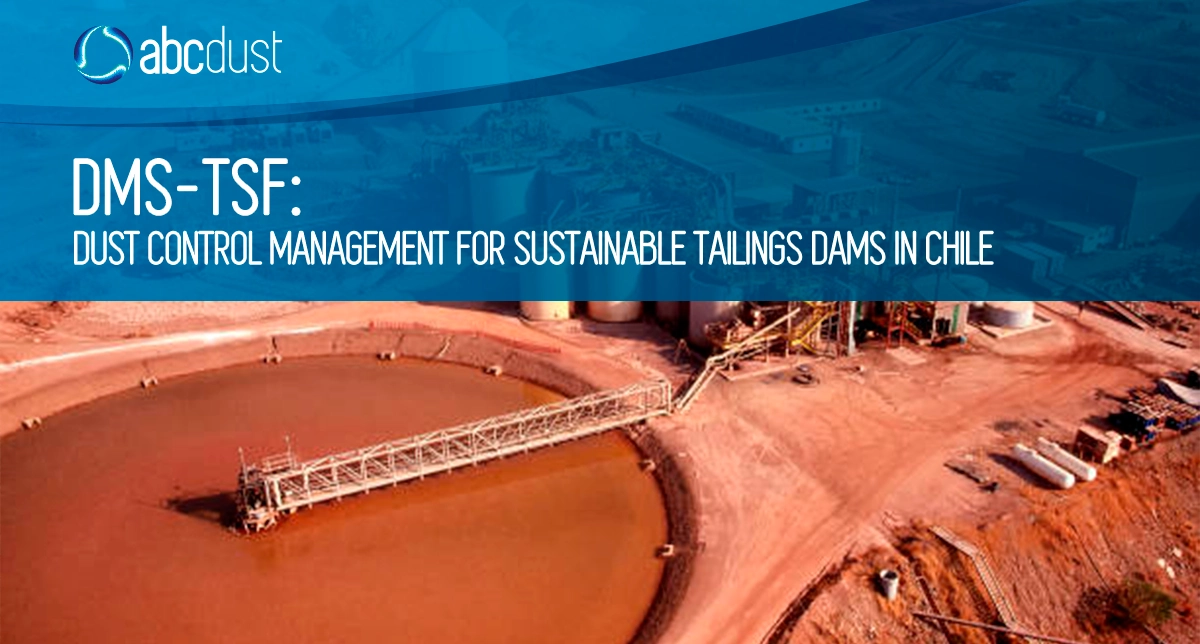

Chile’s position as a global leader in copper exports presents a challenge in managing its massive mining waste.
Georeferenced records from the National Geology and Mining Service in its latest survey (Sernageomin, 2023) show the presence of 795 tailings deposits distributed throughout the country.
Currently, it is estimated that there are more than 800 such tailings piles, concentrated primarily in the desert and semidesert regions of the north and center of the country. Of these, approximately 80% are inactive or abandoned.
In particular, the Coquimbo Region stands out for having the highest number of tailings deposits in the country, with a total of 406 facilities. In contrast, the Antofagasta Region, the hub of large-scale open-pit mining, accounts for the largest authorized physical mass of tailings nationwide, with an approved volume of 10,319 million metric tons. (Ministry of Mining, 2025).
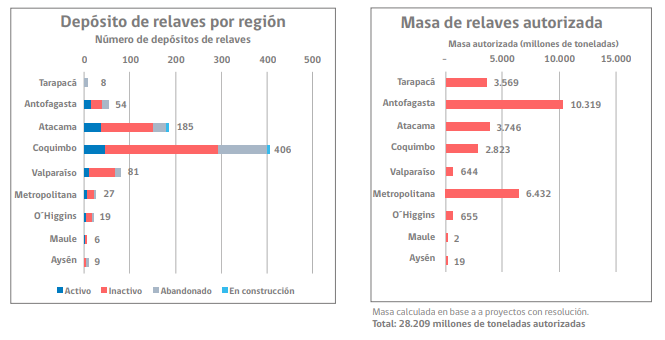
Source: Tailings Agenda 2025/2026.
This duality between deposit density and accumulated volume requires optimal dust control management in order to reduce geotechnical risks and strengthen operational safety, particularly in the face of severe weather events such as the recent frontal systems that have affected south-central Chile.
In their research, Lieberherr, Urtubia, and Orrego (2026) warn of the serious cumulative risks to human health and biodiversity posed by these deposits scattered throughout Chile.
Incidents such as the one that occurred in 2024 at the Minera Cenizas tailings pond (Valparaíso Region) highlight this vulnerability. During heavy rains, solid material was washed away and carried into the streets of nearby towns downstream. This event triggered an environmental alert (EL PAÍS, 2026) and served as a clear signal of the urgent need for preventive management of emissions and stability.
Socio-environmental Implications and the Dangers of Particulate Matter
The exposure of the dry surfaces of tailings ponds to Chile’s weather conditions—characterized by sustained winds, large daily temperature fluctuations, and extreme solar radiation—triggers a severe process of wind erosion.
Under moderate wind conditions, average concentrations of fine particulate matter in the air near these structures range from 0.7 to 1 mg/m³ of respirable PM10 particulate matter.
This emission rate not only severely impairs visibility and local air quality, but also acts as a vector for the dispersion of complex geochemical pollutants such as arsenic, lead, cyanide salts, free crystalline silica, cadmium, mercury, and zinc.
Epidemiological studies at mining sites categorically demonstrate that chronic inhalation of these fractions of silica dust and heavy metals impairs lung function in workers exposed at open-pit mines and in residents of neighboring communities.
The development of pneumoconiosis, pulmonary silicosis, chronic restrictive ventilatory disorders, and an increase in the incidence of lung cancer represent the most severe pathological effects documented as a result of the lack of control over these emissions.
At the ecosystem level, the deposition of this toxic particulate matter on agricultural soils and surface waterways disrupts photosynthesis in native vegetation through leaf clogging, suppresses beneficial soil microbiota, and irreversibly contaminates freshwater sources.
This erosive process degrades the ecological resilience of the region and can undermine the harmonious coexistence between mining operations and local communities, jeopardizing the social license to operate.
To address this situation in a structured manner, the Chilean government, through the Ministry of Mining and in line with the National Mining Policy 2050 and the National Tailings Dump Plan, has enacted the Tailings Agenda 2025/2026.
This milestone in collaborative governance is structured around three lines of action with specific goals aimed at modernizing oversight, incentivizing remediation, and promoting the circular economy.
In direct response to the agenda, the requirements of NCh 3266-2012, and the need for highly reliable, durable, and industrial-scale solutions to sustainably suppress the release of particulate matter from tailings ponds, ABCDust has developed the advanced DMS-TSF® (Dust Master System – Tailings Storage Facilities) technology line.
DMS-TSF®: Advanced and Sustainable Dust Control Technology
DMS-TSF® is a highly efficient dust suppression additive formulated using biodegradable nanopolymers and nonionic surfactants with hydrophilic properties and high molecular affinity.
Unlike traditional suppressants formulated from chloride salts (which corrode machinery, acidify the soil, and destroy the root systems of plants), DMS-TSF® is chloride-free, nonionic, non-toxic, and completely non-corrosive.
The active ingredient in DMS-TSF® operates through a gradual and cumulative physicochemical mechanism of consolidation involving multiple surface microlayers, creating an elastic, hydrophobic layer that withstands extreme rainfall, UV radiation, and freezing temperatures down to −30 °C without cracking.
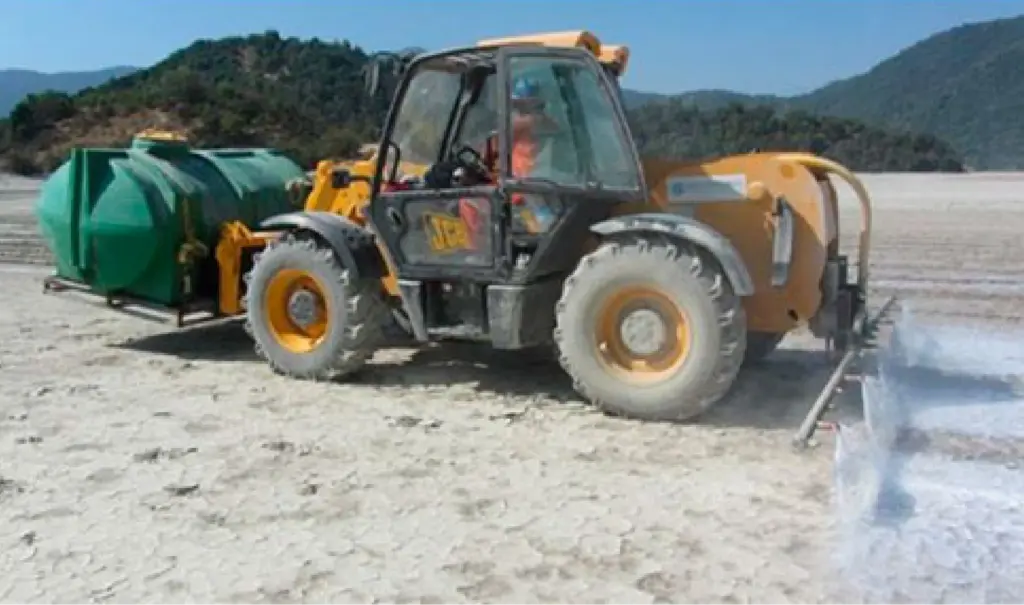
The Canadian BNQ 2410-300 certification confirms that the product is safe for the environment, the microbiome, and revegetation, ensuring uniform, safe, and cost-effective application based on site conditions.
In addition, it integrates with the DMS-ONE digital platform to monitor and predict environmental and operational variables in real time, facilitating decision-making and regulatory compliance.
Do you need to stabilize tailings ponds and reduce wind erosion?
If you’re looking for technical advice on how to reduce particulate matter emissions and help protect the health of communities and the environment, don’t hesitate to contact us.
References
EL PAÍS. (2026, April 23). Chile faces the challenge of turning its mining waste into a new source of critical minerals. https://acortar.link/CHk7ou
Lieberherr, M.; Urtubia, M.; and Orrego, J. (2026). Tailings Dams in Chile: Mining-Related Socio-Environmental Threats. Ecosistemas Edition. https://acortar.link/hsr5VT
Ministry of Mining. (2025). Tailings Agenda 2025/2026: Toward Safe and Sustainable Mining Coexistence. II. Current Status of Tailings Dams in Chile. https://acortar.link/uahODu
National Service of Geology and Mining [Sernageomin]. (2023). https://acortar.link/19eStC