
Fog system · Application equipment
DMS-Fog®
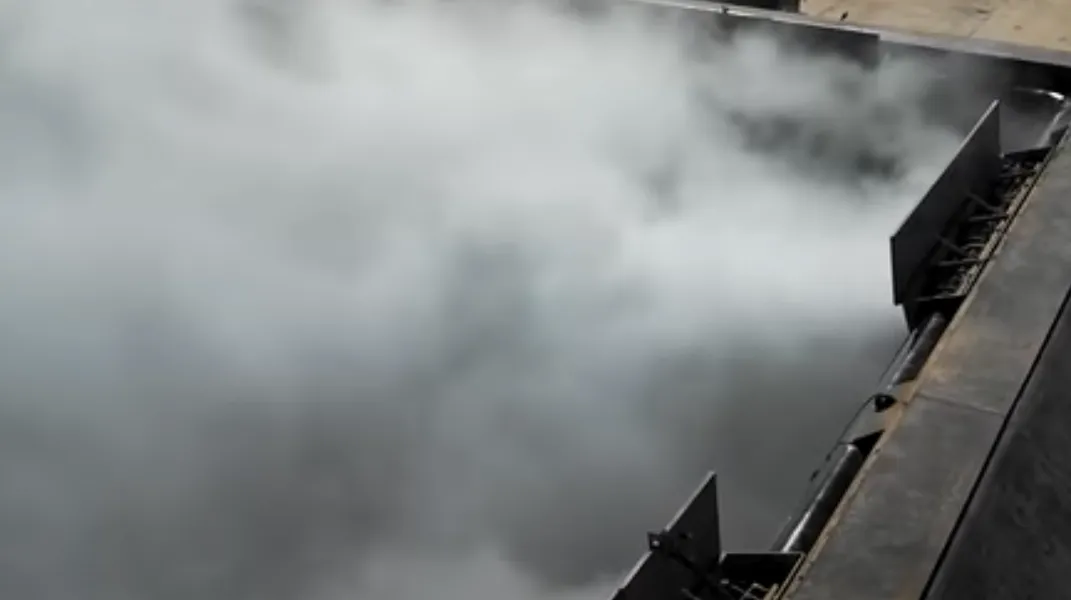
Dry fog and fine mist with tempered water, capturing fine dust at the source with a fraction of the water. DMS-FOG nozzles designed by ABCDust in 316 stainless steel, patent pending and made in Canada, for hoppers, crushers, chutes and conveyor transfers.
At a glance
- Dry fog
- 4–12 µm droplets, matching the size of the dust (≈ 10 µm average)
- Fine mist
- 30–80 µm droplets
- PM2.5 removal
- 75–95% at the emission point
- Water use
- 95–99% less than conventional wetting
- Moisture added to material
- 0.1–0.2%, no mud
- Tempered water
- 30–40 °C
- Extreme climate
- options down to −40 °C
- Nozzles
- 316 stainless steel
- DMS-TDS® dilution
- 1:10,000, 0.5–1% wetting
- Efficiency with DMS-TDS®
- 90–95%
- Filtration
- water: 50–150 mesh; air: 3 µm
- Enclosures
- IP66
Data from ABCDust’s DMS-FOG dry fog technical sheet (2026) and the original product sheet.
- dry fog droplet size
- 4–12 µm
- PM2.5 removal at the emission point
- 75–95%
- less water than conventional wetting
- 95–99%
- functional options for extreme climates
- −40 °C
How dry fog works
The DMS-FOG nozzle mixes compressed air and water to form microdroplets the size of respirable dust. Designed and built by ABCDust, patent pending and made in Canada.
- Large droplet
- the dust flows around it with the air and stays airborne.
- Fog droplet
- it strikes the particle, encapsulates it and settles.
- 01
Droplets the size of dust
Air and water mix in the nozzle, and a resonator breaks the jet into microdroplets.
- 02
Collision and agglomeration
A large droplet deflects the dust along with the air; a microdroplet intercepts and encapsulates it.
- 03
Settling at the source
The agglomerate falls back into the material flow and the dust does not spread into the surroundings.
Dry fog and fine mist, in one system
4–12 µm
Dry fog
Captures PM10 and PM2.5 at hoppers, crushers, screens, chutes and conveyor transfers. It wets the material by only 0.1–0.2%, without creating mud.
30–80 µm
Fine mist
Complements dry fog on coarser particles and in more open discharge areas.
30–40 °C
Tempered water
The skid filters and heats the water. With lower surface tension, the fog is finer and travels farther, does not freeze in winter and performs the same around the clock, with less compressed air.
−40 °C
Functional options for extreme climates
Skid and manifold configurations that operate down to −40 °C, for high-altitude sites, Canadian winters and continuous cold-season operation. Ask us about the right option for your site.
Compared with conventional wet suppression
| Criterion | DMS-Fog® dry fog | Wet spraying |
|---|---|---|
| Water use | 95–99% lower | High |
| Moisture in the material | 0.1–0.2%, no mud | Higher; mud and build-up on equipment |
| Fine dust capture | 75–95% of PM2.5 | Low: the large droplet deflects the fine particle |
| Winter operation | Tempered water; options down to −40 °C | Risk of freezing |
| Water and energy use | Activates only at each discharge | Usually runs continuously |
Complete, modular and measurable
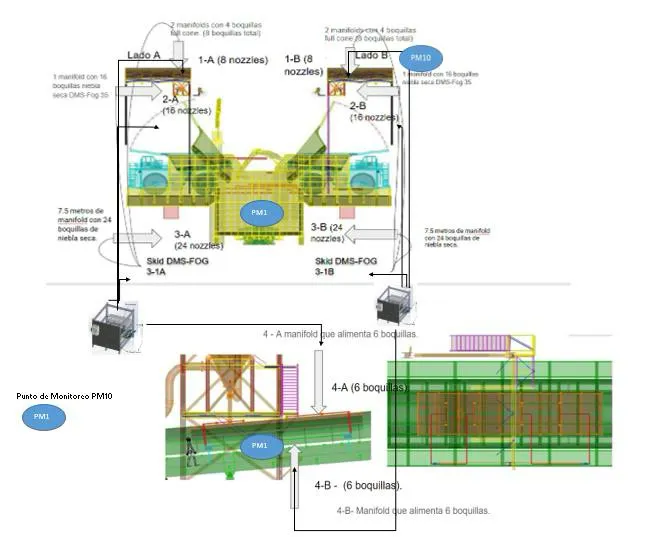
- DMS-FOG skid
- 1,000 L thermostatic tank, 7 HP pump, 4 water filters and 4 air filters, solenoid valves and control panel. Optional additive dosing.
- Modular manifolds
- 4.8 m stainless steel bars with 16 nozzles, an adjustable swivel and a fog reach of up to 70 m².
- ABCDust nozzles
- DMS-FOG in 316 steel, patent pending and made in Canada.
- Control and monitoring
- Manual mode, or automatic on a signal from the control room, pressure alarms and optional PM10/PM2.5 monitoring.
Generation and control
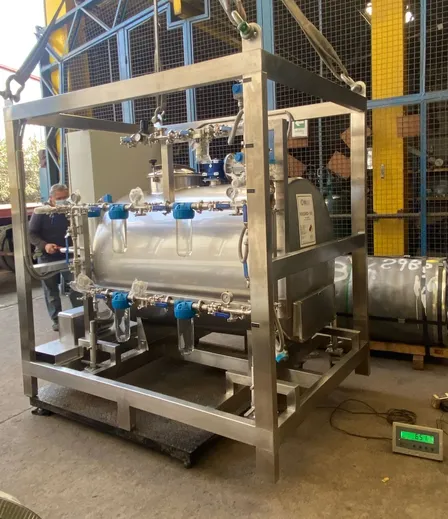
DMS-FOG skid
A modular unit that filters, tempers and doses the water and air for all the bars. It is assembled and tested in the workshop.
- 1,000 L stainless steel thermostatic tank
- 7 HP electric pump
- 4 water filters and 4 air filters
- Solenoid valves, pressure regulators and gauges
- Manual, semi-automatic or remote panel, with pressure alarms
- 1% additive dosing (optional)
- 4 water and air outlets; stainless steel cage on wheels
- crusher, conveyors and chute from one skid
- 6,000 tph
- 850–1,500 kg depending on configuration
- 2.4 × 1.5 × 1.5 m
- 50/60 Hz, 25 kVA
- 380 V · 3-phase
- water 1–1.5 bar · air 6–7 bar
- 1″ / 1½″ NPT
Distribution
DMS-FOG manifolds
Modular stainless steel bars that carry the fog to each emission point: hoppers, crushers, chutes and conveyors.
- 4.8 m bar with 16 DMS-FOG 35 nozzles
- 1″ piping for water and 1½″ for air
- Shut-off valve per nozzle, and drains
- Swivel to aim the fog at the source
- Can be coupled to a second bar; 7.5 m versions with 24 nozzles, and versions for conveyors
- Compatible with DMS-WF 36® wind fences
- fog reach per bar
- 70 m²
- water per bar (8 psi)
- 654 L/h
- air per bar (75 psi)
- 176 cfm
- weight of the 4.8 m bar
- 60 kg
Atomization
DMS-FOG nozzles
Air-and-water nozzles designed by ABCDust, patent pending and made in Canada in 316 stainless steel.
- DMS-FOG 35 and DMS-FOG 25 models
- Body with water (1/8″ NPT) and air (1/4″ NPT) inlets
- Mixer and stem: air and water combine before the orifice
- Resonator and head: break the jet into microdroplets
- Complementary family: adjustable DMS-SW and full-cone FCS for fine mist and spraying
- average dry fog droplet
- ≈ 10 µm
- reach per nozzle
- ≈ 5 m
- water per nozzle
- 40.9 L/h
- air per nozzle
- 11 cfm
Where it is installed
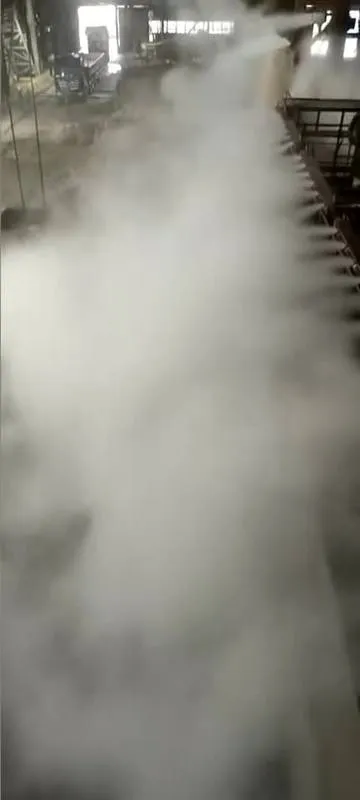
Conveyor beltsFog while the belt carries material. 
StockpilesFog at the stacker discharge onto the pile, inside the storage dome. 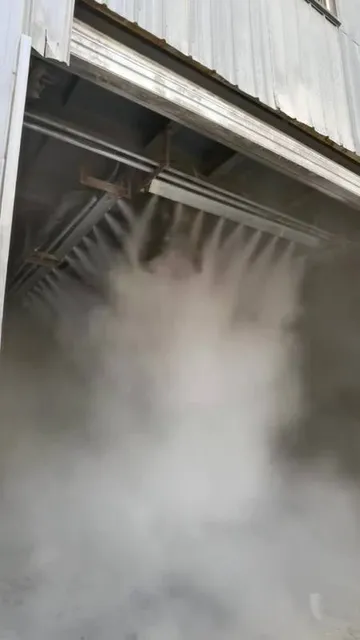
Chutes and transfersCapture at transfers and at the secondary crusher feed.
Efficiency measured, not assumed
Each installation is calibrated with Trolex AIR XD real-time particulate monitors and EPA reference equipment, using a methodology validated at large mining operations.
- 01
Baseline
PM1, PM2.5, PM4 and PM10 measured along the crushing line and at conveyor skirting boxes, with wind, humidity, temperature and tph recorded.
- 02
Calibration
Active nozzles, pressures and additive dose are adjusted until suppression reaches 80–85%.
- 03
Guarantee ≥ 75%
Calibration leaves a margin above the required efficiency, verified with the same methodology.
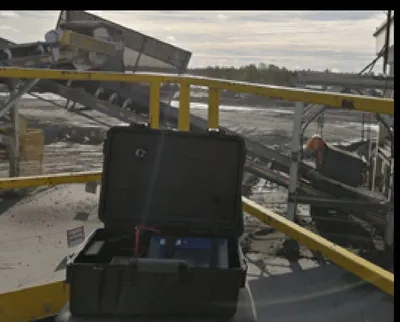
AIR XD
Continuous monitoring with Trolex AIR XD units
Real-time area monitor for high-dust environments: it measures PM1, PM2.5, PM4.25, PM10 and total dust with an optical particle counter, with no filters, pumps or moving parts. IP66 rated, with ATEX, IECEx and MASC certifications, relay and 4–20 mA outputs, and Modbus to integrate with the plant SCADA, plus 4G connectivity.
Trolex AIR XD datasheet on trolex.com ↗Turnkey implementation
- 01Survey and engineering
- 02Manufacturing and workshop testing
- 03Supervised installation
- 04Commissioning and calibration
- 05On-site training
- 06After-sales support
- manufacturer’s warranty
- 24 months
- after-sales technical support
- 12 months
- of recommended spare parts
- 1 year
More than 20 years of development
DMS-Fog® can produce a dry fog of 4–12 µm or a fine mist of 30–80 µm water droplets to cover the dust source and prevent dust particles from becoming airborne, or apply dust control additives to prevent dust emissions. Dry fog and fine mist systems have more than 20 years of development as an effective dust suppression method, with reduced water consumption and low capital and operating costs.
Boost suppression efficiency with our DMS-TDS® additives
For greater suppression efficiency, DMS-Fog® is combined with our DMS-TDS® additives diluted at rates of 1:10,000 and 0.5–1% wetting, applied with different nozzles depending on the application objective, saving water and operating costs with a suppression efficiency of 90–95%.
Monitoring and optimization of dry fog and fine mist with DMS-ONE®
- The DMS-Fog® control system offers automation and remote optimization using input and output sensors and EPA-standard PM10 and PM2.5 monitors to optimize dust suppression and resource use. DMS-Fog® has an on-site control screen (PLC) that can be integrated with our DMS-ONE® platform.
- The PLC controls the air, water and additive system, operating the air flow, water flow and (optional) additive dosing valves of each dry fog and/or fine mist bar or set of bars. Each circuit has 50 to 150 mesh water filters, a 3 µm air filter, two pressure switches (air and water), two solenoid valves, pressure transducers, a pressure regulator and automatic control racks. It includes built-in time relays and auxiliary contacts for remote start, pilot lights (manual, automatic, off), ball valves for water, a manual shut-off valve for air, and fuses. The system is housed in IP66 enclosures, resistant to water and dust.
Installation at a conveyor transfer
Two DMS-FOG manifolds mounted under the discharge pulley capture the dust right where the material drops onto the next belt, with protected nozzles and shut-off valves within reach for maintenance.
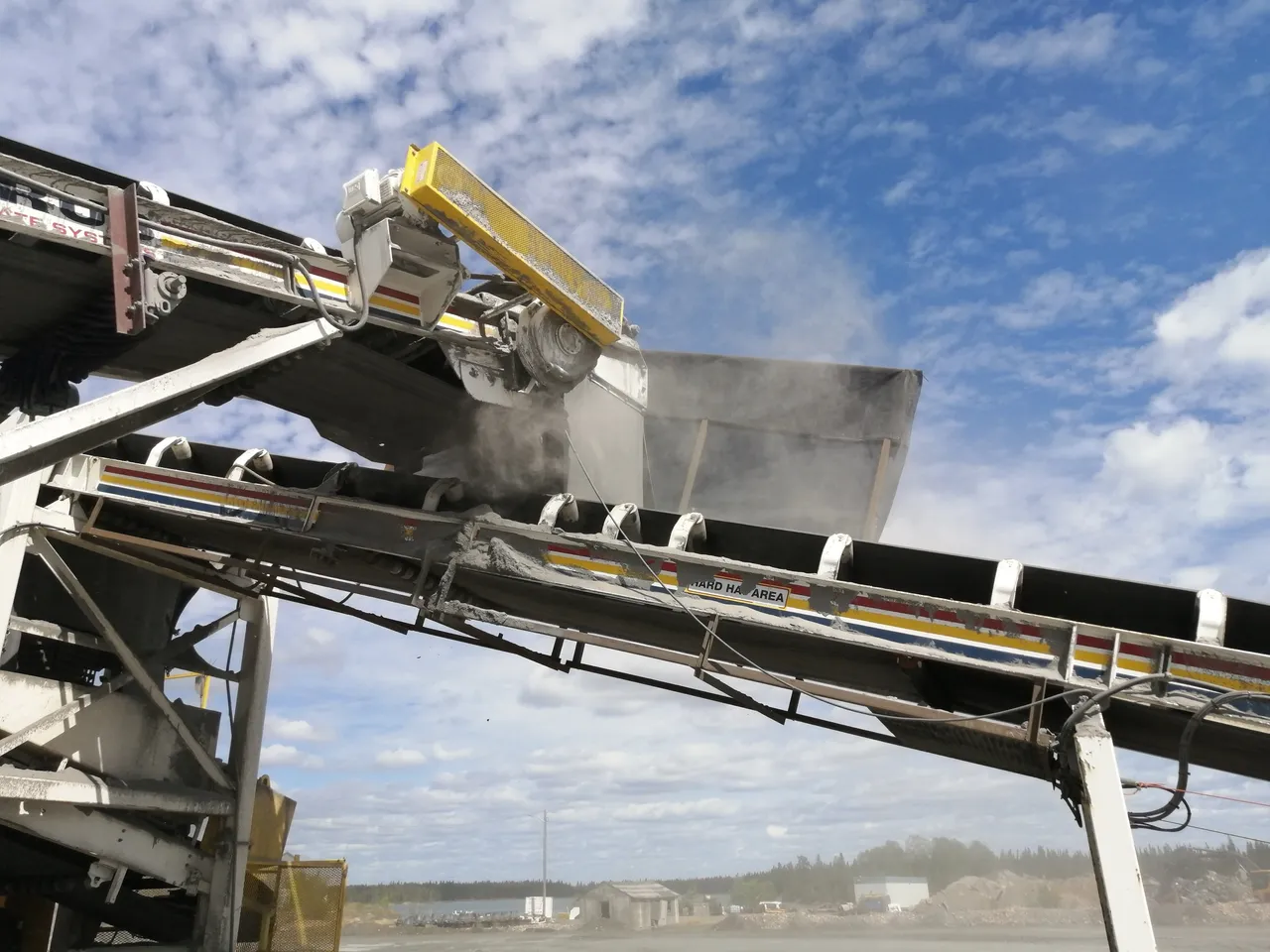
Transfer point between conveyors, with a dust cloud at the discharge. 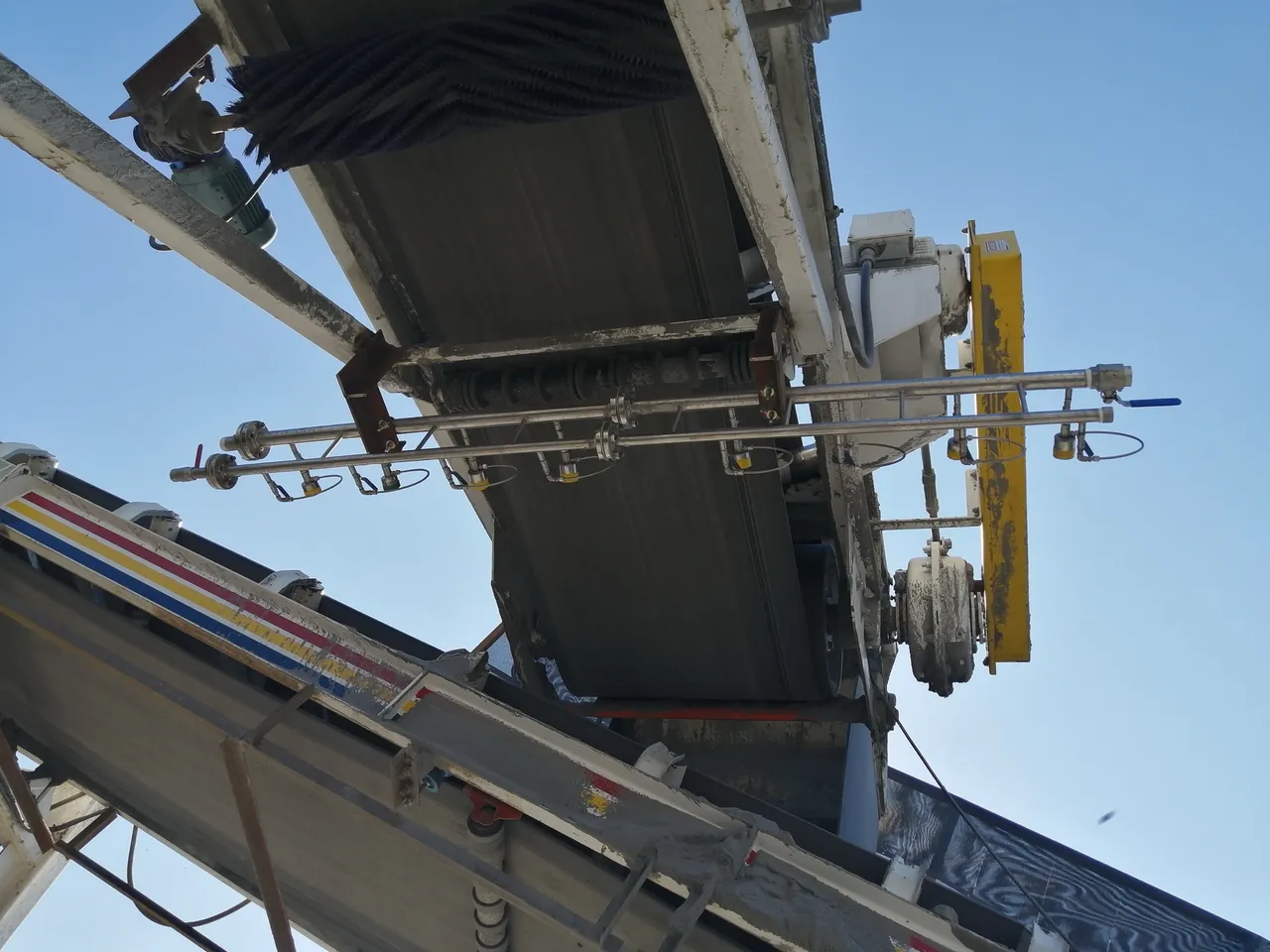
Two DMS-FOG manifolds under the discharge pulley. 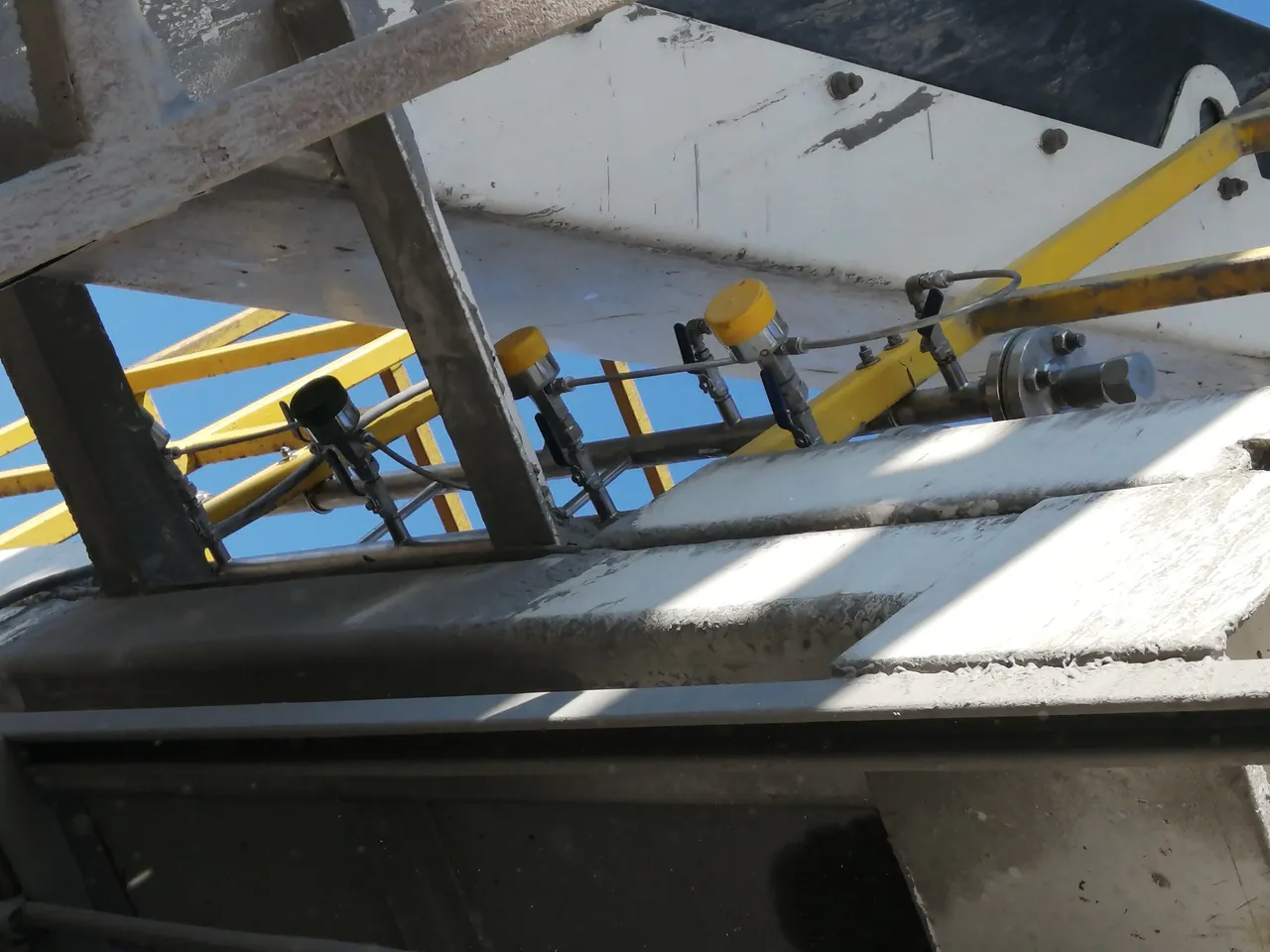
Nozzles with yellow guards, and shut-off valves. 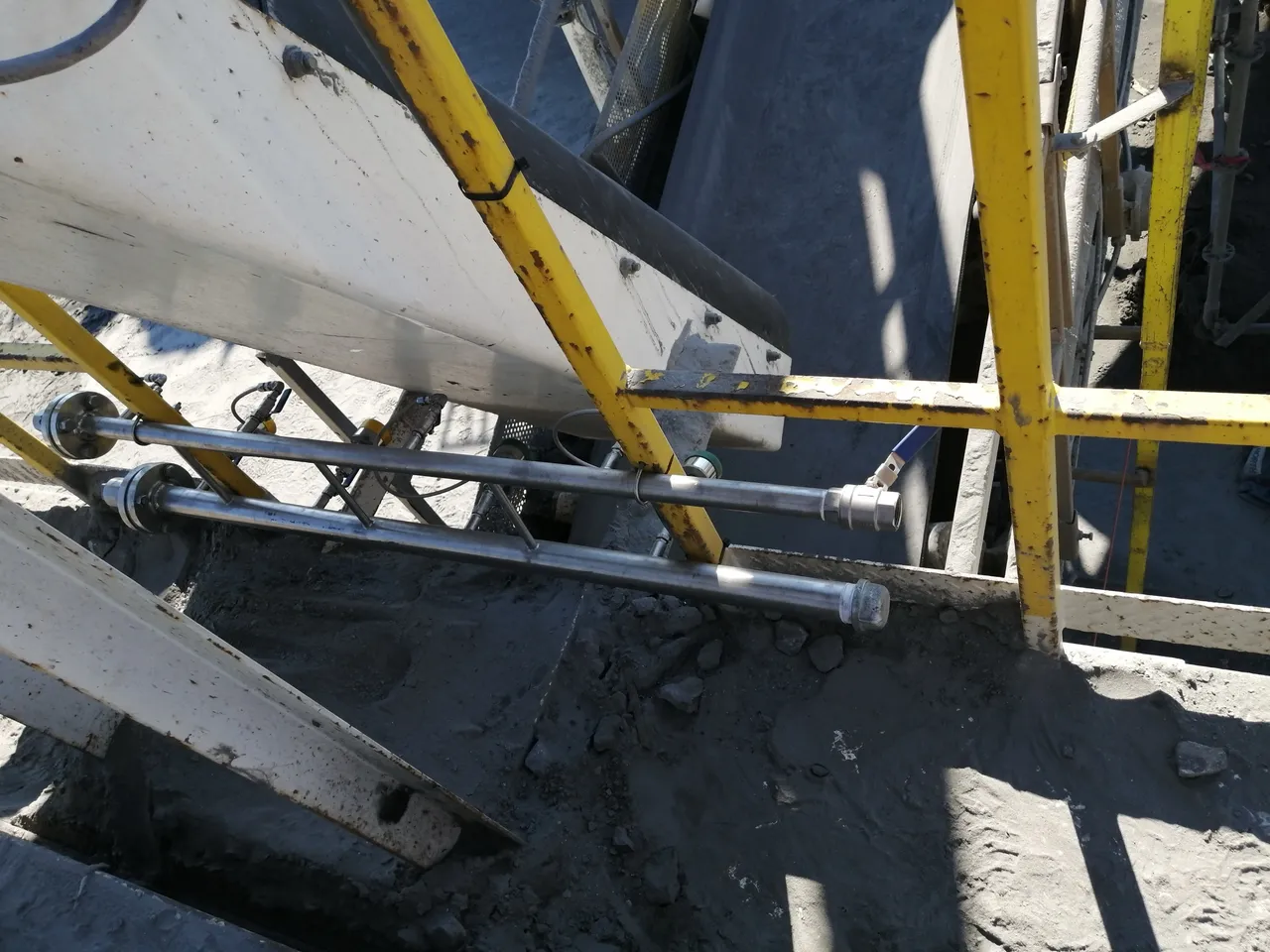
Manifolds mounted alongside the transfer structure.
Assembled and tested in our workshop
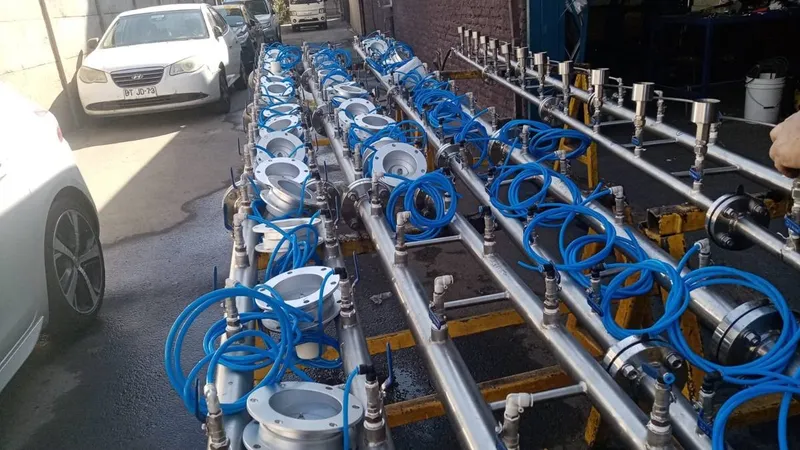
Stainless steel fog manifolds with air hoses, ready for shipping. 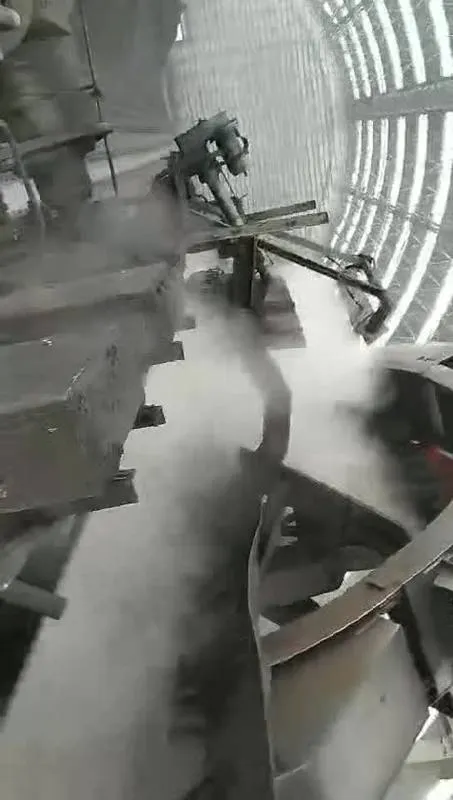
Fog test: manifold running over a hopper. 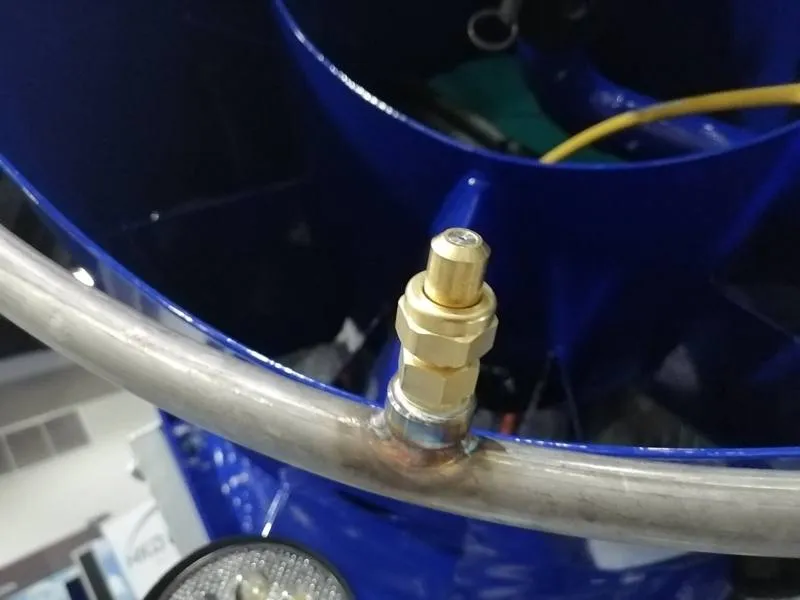
Close-up of a nozzle welded to the distribution pipe. 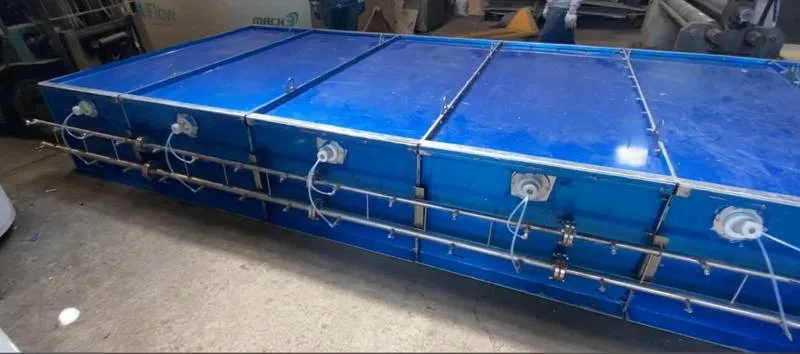
Conveyor enclosure with fog bars along the sides. 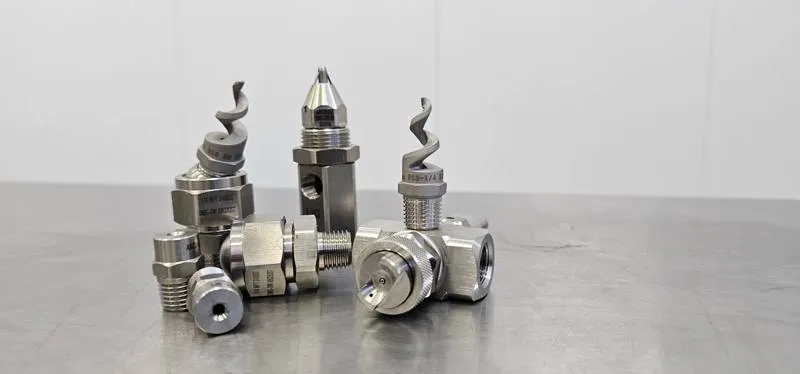
The ABCDust nozzle family in 316 steel.
What we are asked most
Does dry fog wet the material?
Not to any significant degree: it adds only 0.1–0.2% moisture, so it does not create mud or affect downstream processes.
Does it work in winter or at altitude?
Yes. The skid tempers the water to 30–40 °C, which prevents freezing and keeps the same performance day and night, all year round. There are also functional options for operating down to −40 °C.
How much water does it use?
Between 95 and 99% less than conventional wetting. For reference, a 16-nozzle bar uses 654 L/h, and the system activates only during each discharge.
How is efficiency proven?
We measure a PM10 and PM2.5 baseline with EPA reference monitors, calibrate the system to 80–85% suppression, and verify the committed efficiency, at least 75%, with the same methodology.
What does the site need for the installation?
Industrial water (1″ NPT, 1–1.5 bar), compressed air (1½″ NPT, 6–7 bar), 380 V three-phase power and room for a 2.4 × 1.5 × 1.5 m skid. We visit the installation points before manufacturing.
Tell us the emission point, the tonnage and the climate
With that, we size the skid, manifolds and nozzles for your crusher, conveyor or chute.
Request system sizing