Monitoring
Air quality and environmental monitoring solutions, in line with regulations, that let you make sure your dust control measures are delivering results.
See what the platform doesMonitoring to comply, and to run a better operation
Nobody monitors for the sake of it. Regulators require environmental reports, and operations need to know whether dust control is meeting its target. That is what we measure for.
Regulatory compliance
Data for the environmental reports your regulator requires, measured with recognized instruments and methods.
Operational control
Knowing, sector by sector, whether the treatment meets the agreed target and where to act.
The right number of sensors
There is no need to fill the trucks with sensors. Three to five well-placed units provide the data the forecast needs.
The solution, not just the technology
We measure to control dust with additives, dry fog, cannons and watering plans, and to prove that it works.
Monitoring methods
Five complementary methods, from sensor to laboratory
To show how much dust is reduced, optimize water and product use, and support worker exposure assessment. This is our recommended offer: the final design depends on the site and the jurisdiction.
- 01
Continuous PM10 and PM2.5 + weather
What we deployIndustrial optical monitors; wind, temperature, humidity and rain.
What it makes possibleAlerts, episode identification, control tracking and watering automation.
PriorityThe basis of every installation
- 02
Personal sampling of respirable dust and silica
What we deployPersonal pumps, cyclones and filters; laboratory gravimetric and silica analysis.
What it makes possibleExposure assessment by position, task and shift; before-and-after comparison.
PriorityEssential in crushing and rock handling
- 03
Reference PM10 and PM2.5 measurement
What we deployGravimetric samplers or analyzers using a method recognized by the regulator.
What it makes possibleSensor validation and regulatory environmental monitoring where required.
PriorityDepending on permit and environmental risk
- 04
Road emission campaigns
What we deployMobile measurement with a defined methodology; EPA OTM-34 where applicable.
What it makes possibleSuppression efficiency, treatment comparison and duration of effect.
PriorityKey for mine roads
- 05
Cameras synchronized with sensors
What we deployVideo, vehicle and event detection, linked to PM and weather data.
What it makes possibleSource identification, root-cause analysis and predictive control with ZERODUST AI, within DMS-ONE®.
PriorityTechnology differentiator
Roads, following the EPA OTM-34 guidance
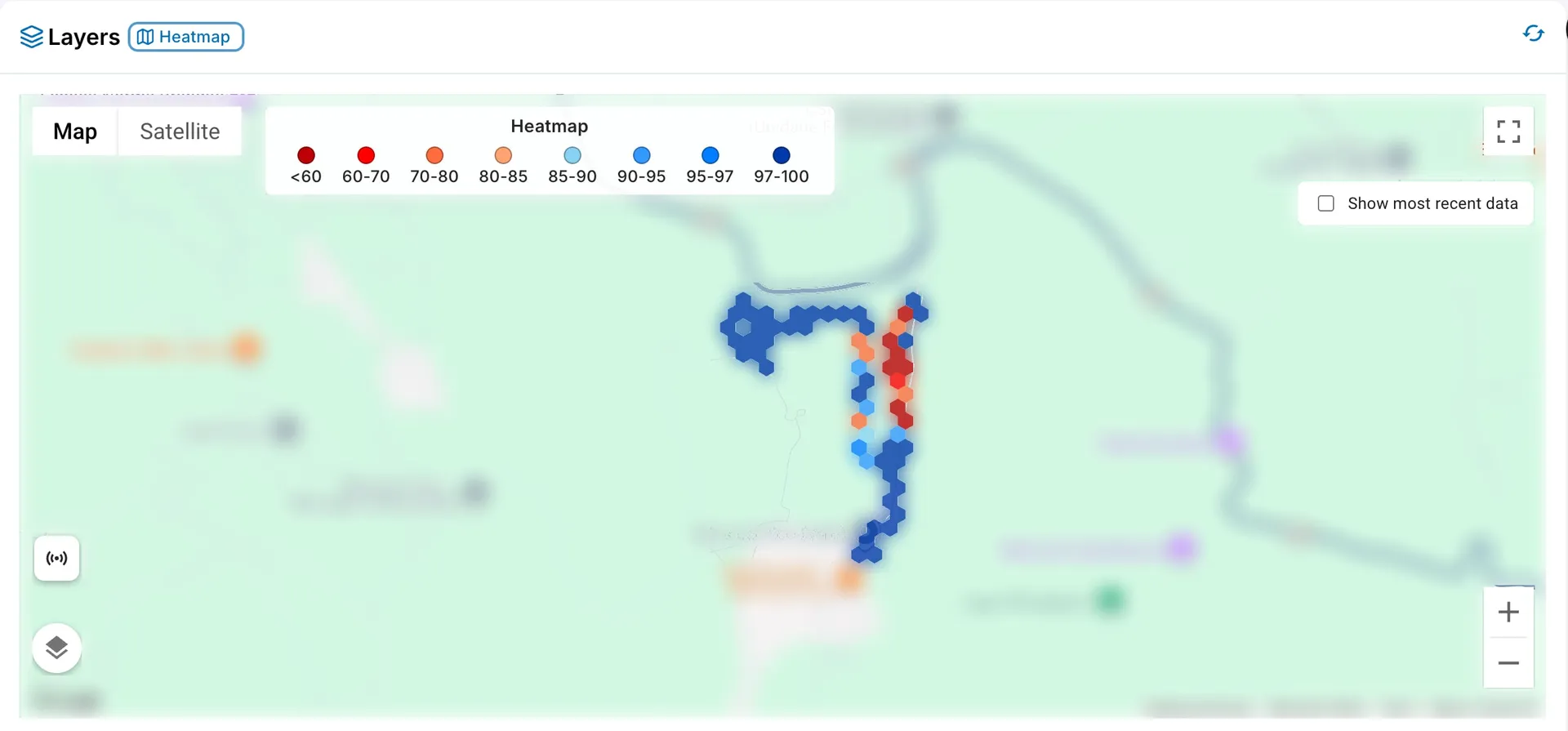
We measure road dust following OTM 34 from the US Environmental Protection Agency: a TSI DustTrak II 8530 monitor with the probe behind the rear tire, at constant speed over set road sections, against the baseline of the same road. Traffic and conditions for each test are documented.
What we monitor, and to which standard
Environmental and operating variables in one system, so every reading can become a decision.
Particulate matter
- Total PM (TSP)
- PM10
- PM2.5
- Respirable crystalline silica
Gases
- NOx
Weather
- Temperature
- Wind speed and direction
- Relative humidity
- Rain
- UV radiation
Operations
- Vehicle traffic
- m³ of water applied
- Litres of additive applied
- CO₂ emissions
Service and methodological basis
| ABCDust service | Proposed methodological basis |
|---|---|
| Occupational exposure to dust and silica | NIOSH 0600 + 7500, with a personal sampling plan and a competent laboratory |
| PM10 and PM2.5 environmental monitoring | EPA Appendix J/L or FRM/FEM equipment, as local requirements dictate |
| Validation of road treatments | EPA OTM-34, where applicable, with traffic and test conditions documented |
| Dust collector assessment | EPA Method 5; 201A is added if PM10 and PM2.5 fractions are required |
| ZERODUST AI continuous control (DMS-ONE®) | Sensors + weather + cameras, checked against reference measurements |
On site
- Roads: mobile monitoring with a TSI DustTrak II 8530.
- Reference: gravimetric sampling with BlueBox®.
- Baseline measured at the same point before treatment.
Monitor → Treat → Optimize
01
Monitor
Fixed and GPS-equipped mobile sensors, cameras with computer vision, weather stations and reference gravimetric sampling. The baseline for the point is established first.
02
Treat
An hour-by-hour dust risk index built on the weather forecast, watering scheduled by road segment and dose, an optimal route, execution through the operator app, and remote control of the equipment on site.
03
Optimize
Suppression efficiency computed against the baseline, adherence to schedule, actual water and additive against plan, and road regularity. Exportable report.
Monitoring equipment
- Red-Box® — continuous PM and silica monitoring
- BlueBox® — reference gravimetric sampling
- DMS-AQS® — environmental and air quality station
- DMS-Extremo® — dust monitor
- V-Sense — friction (Vericom)
- Motion — acceleration and braking distance
- 24/7/365 visual monitoring with plume detection
Monitoring service
DMS-ONE®
DMS-ONE® turns data into action
The platform gathers readings from the equipment, anticipates dust risk and schedules the treatment. It then compares every reading with the baseline and shows you whether you are on target.
- 01MonitorContinuous readings from fixed and mobile sensors, cameras and weather stations.
- 02TreatDust risk index, watering schedule by road segment, routes and alerts to operators.
- 03OptimizeEfficiency against the baseline, water and additive against plan, and exportable reports.