
Tailings storage facilities
Wind-erosion control on tailings deposits with a crust-forming, chloride-free suppressant
Book a meeting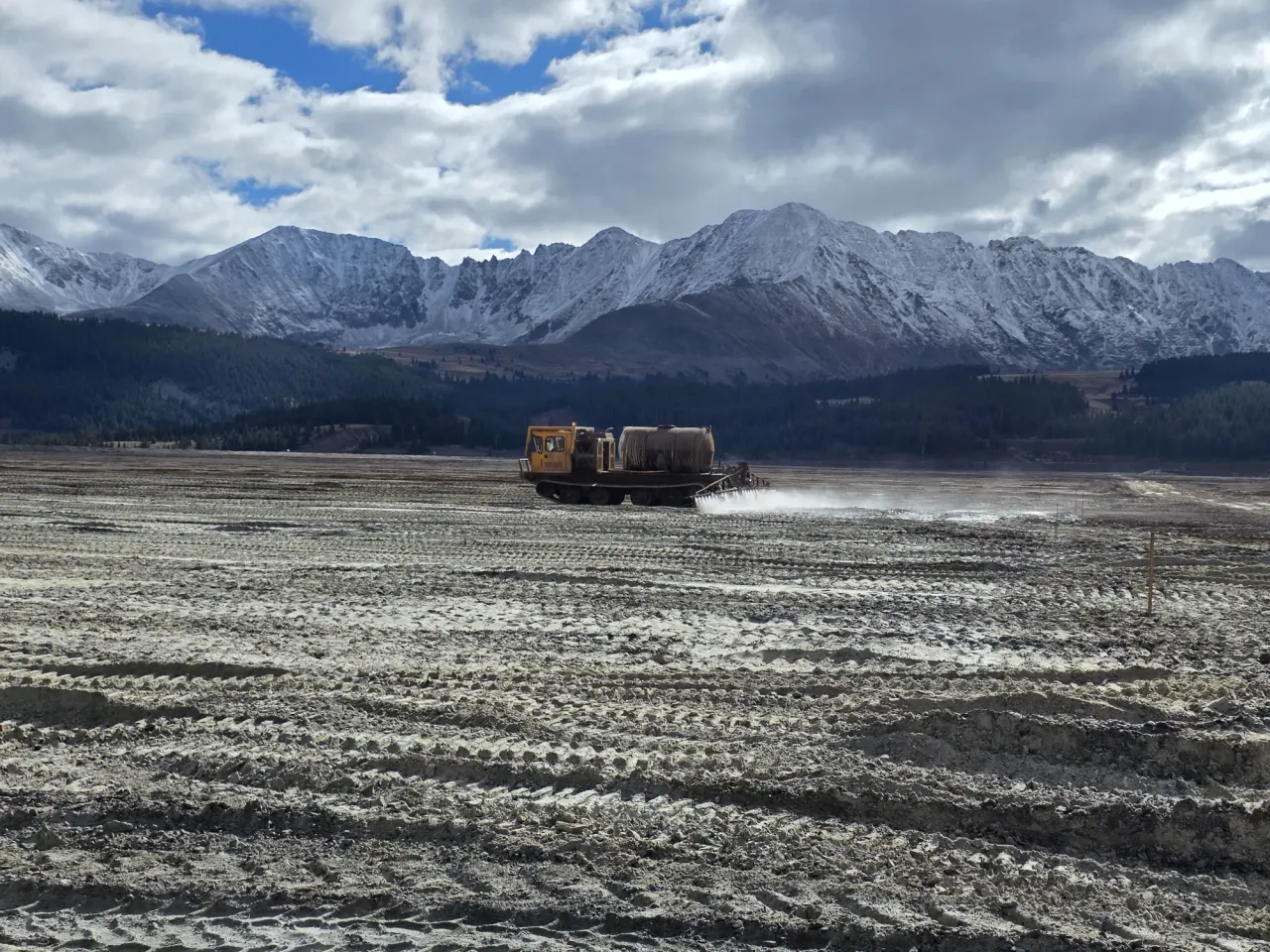
A tailings deposit is a large, dry surface exposed to wind: the fine fraction carries respirable crystalline silica and metals, and an episode gives no warning, because it depends on the wind. DMS-TSF® is ABCDust's additive for tailings dams, stockpiles and waste rock piles: nanopolymers and surfactants that form a stable, chloride-free crust on the surface.
At a glance
- Product
- DMS-TSF®, crust-forming suppressant
- PM10 and PM2.5 suppression
- 85–90%
- Treatment life
- 6–24 months
- Cold resistance
- down to −30 °C
- Chlorides
- none
- Mine closure
- compatible with closure and revegetation
- Application
- water trucks, hoses, water cannons and aerial application
- Packaging
- 1,000 L IBC tote (122 × 102 × 122 cm)
- Storage
- −30 °C to 35 °C
- Shelf life
- 12 months
Source: DMS-TSF® technical data sheet and ABCDust tailings brochure (2024).
- PM10 and PM2.5 suppression
- 85–90%
- treatment life
- 6–24 months
- cold resistance
- −30 °C
The challenge
An untrafficked surface that the wind erodes
There is no traffic on a tailings deposit: the trigger is the wind, and the episode depends on it. The application technique is chosen according to the bearing capacity of the tailings and the topography.
- Typical conditions
- Large untrafficked surfaces, wind as the trigger, nearby communities, environmental permit requirements, and closure and remediation plans.
- A source of fine dust
- Tailings dams are the third-largest source of fine dust in mining (CIM, 2020).
- What the dust contains
- Tailings can contain heavy metals and chemicals such as cyanide, arsenic, lead, silica, cadmium, zinc and mercury, among others (Sernageomin, 2015).
- Why it is controlled
- Controlling emissions from tailings dams is mandatory, because of their impact on nearby communities, flora and fauna.
How a crust-forming suppressant works
DMS-TSF® is a water-soluble, crust-forming polymer formulation that is resistant to UV radiation, rain and cold. It is sprayed onto the exposed surface and builds up multiple microlayers of suppressant film.
- Dry, untreated tailings
- The surface stays loose and exposed: every wind episode carries off the fine fraction, with respirable crystalline silica and metals.
- Tailings with a crust
- The nanopolymers and surfactants in the formulation create a stable dust-control crust that keeps dust under control over the long term.
Chloride-free
Complements the closure and remediation plan
DMS-TSF® contains no chlorides, has no negative effects on plants or on colonizing microorganisms, and is compatible with closure and revegetation initiatives.
6–24 months
Treatment life
A DMS-TSF® treatment lasts 6 to 24 months. The dose is calibrated in the laboratory with samples of the site's tailings.
Before application
The dose is calibrated in the laboratory with your tailings
The dose is calibrated in the laboratory with samples of the site's tailings, a drying oven and wind tunnels, and the application technique is chosen according to the bearing capacity of the tailings and the topography.
- 01
Analysis of the deposit
Review of the topographic reports for the dam and its slopes, the bearing capacity, tailings samples, and the emission and weather records.
- 02
Additive selection and testing
Additives are tested on the samples to achieve effective, long-lasting control.
- 03
Drying oven and wind tunnel
Calibration of the dose for the site's tailings.
- 04
Application technique
Techniques are combined according to the bearing capacity of the tailings and the topography of the areas of the dam to be treated.
Application techniques
The techniques are combined to achieve an even, safe application, according to the bearing capacity of the tailings and the topography of each area.
- Water truck
- Spraying from a truck, where the tailings can bear traffic.
- Hoses
- Manual spraying with a hose, for slopes and hard-to-reach sectors.
- Long-range monitors
- Spraying at a distance from the edge of the deposit. DMS-Cannons® cannons project mist, with or without additive, up to 120 m in still air, and count slopes and tailings among their uses.
- Helicopter
- Aerial spraying, for surfaces with no ground access.
- Light aircraft
- Aerial spraying by light aircraft, for large areas.
- T-TRACKS®ABCDust temporary tracks
- Modular temporary tracks that let equipment travel over tailings with low bearing capacity.
Field record · October 1 and 2, 2026
Application in the field
Application with a spray boom: the boom is unfolded, the surface is sprayed in strips and, the next day, the crust is checked by hand.
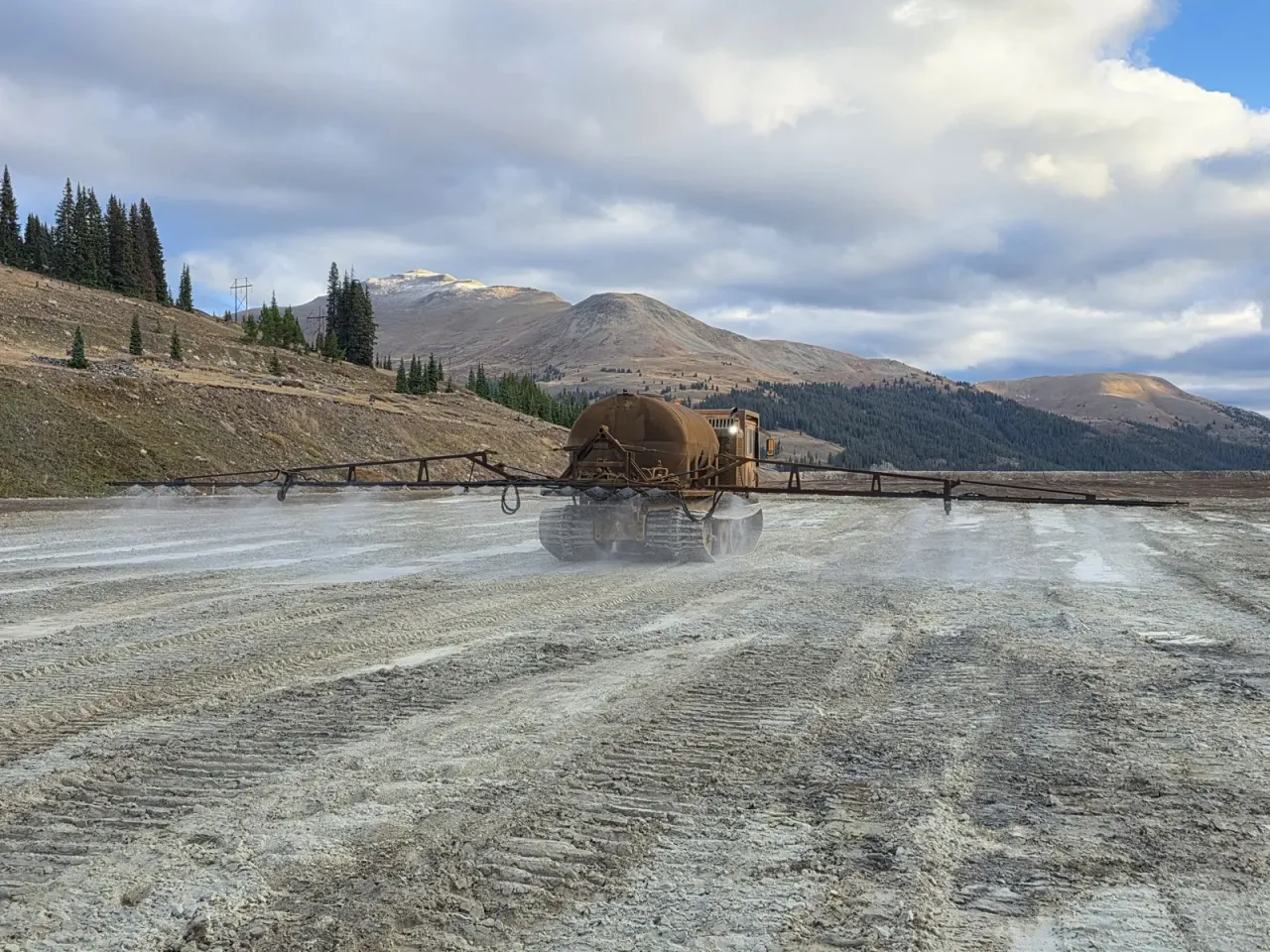
01 · Boom unfolded to its full width, with the wet strips in view. 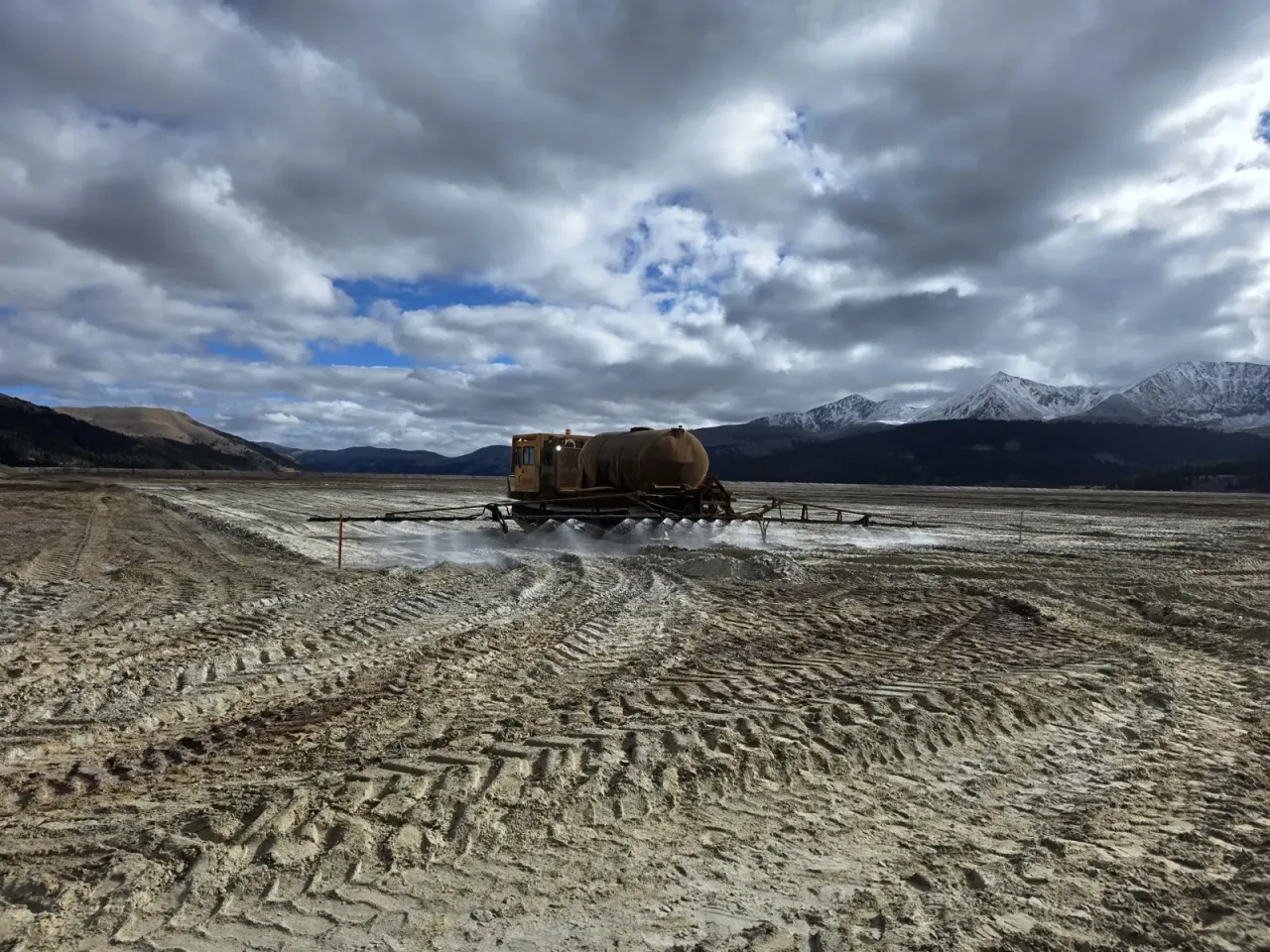
02 · All nozzles operating: a row of spray fans under the boom. Video, 10 s · The carrier drives away and leaves a treated strip next to the untreated ground. October 1, 2026. 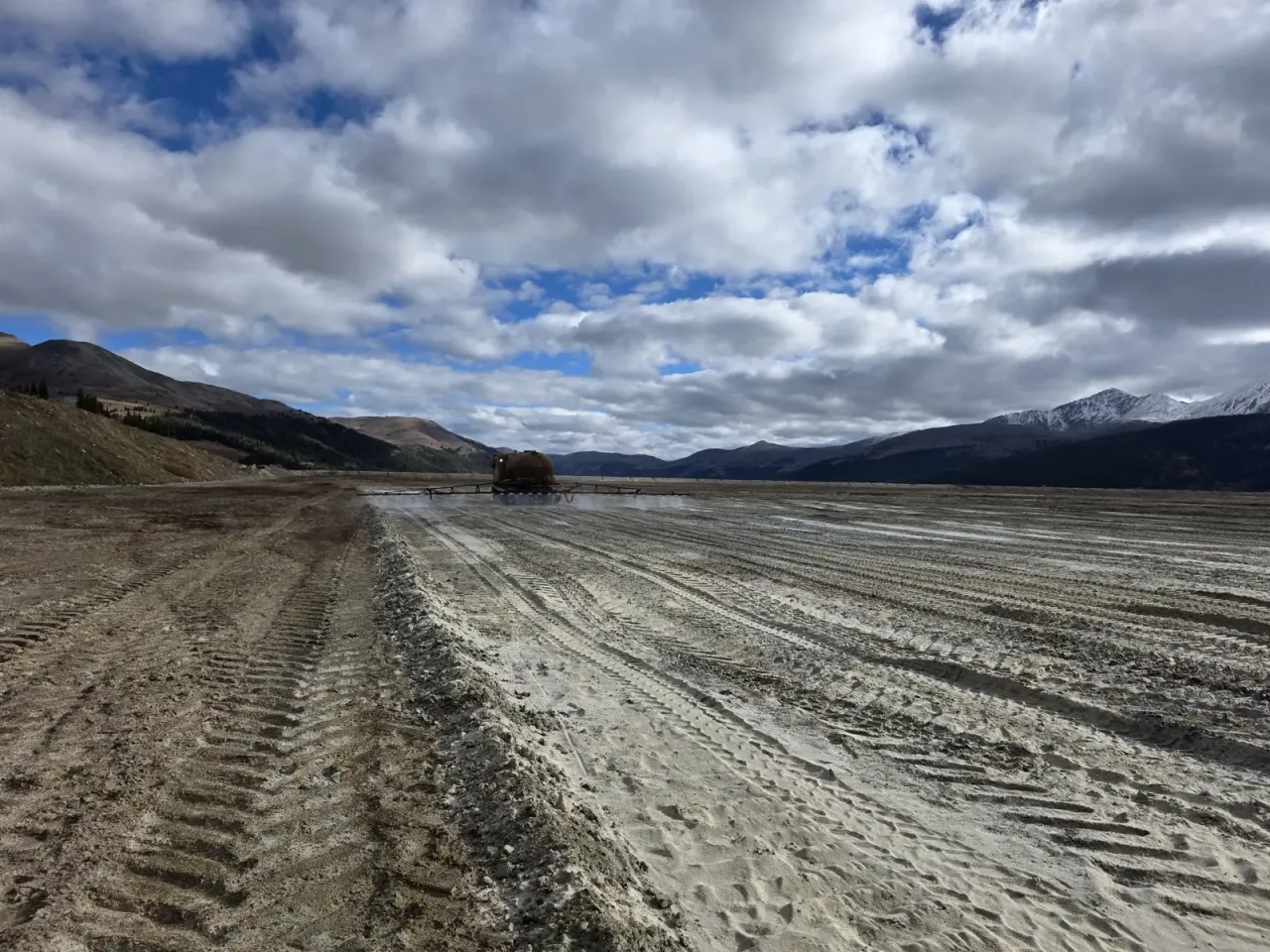
03 · Treated strip: on the right, the sprayed strips, paler; on the left, the unsprayed surface. 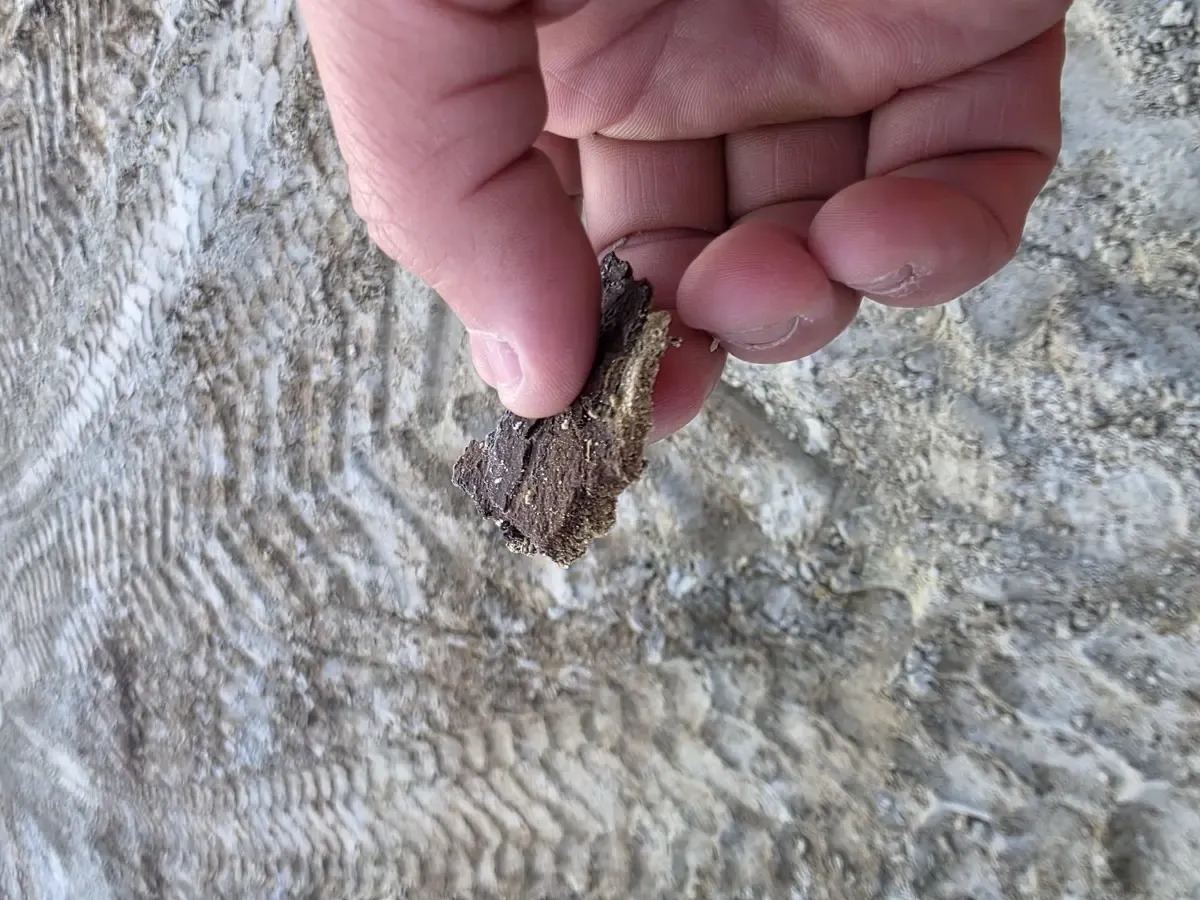
04 · Crust fragment lifted by hand on the day of application. 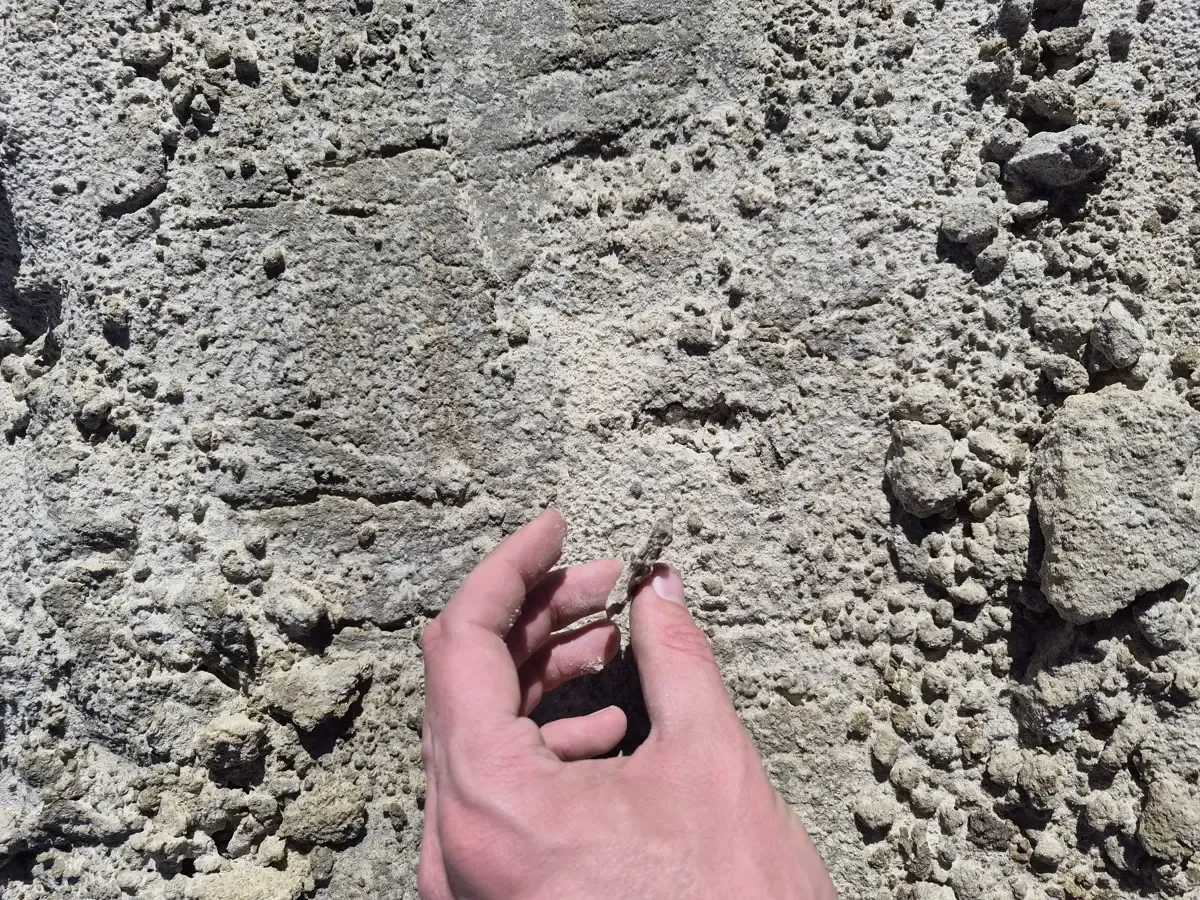
05 · Crust the next day: a hardened plate lifts off in one piece. October 2, 2026.
Our approach
How the result is demonstrated
The same method as on the rest of the site, Monitor → Treat → Optimize: a measured baseline, treatment at the source, and verification against that same baseline.
- 01
Monitor
DMS-AQS® with a weather station and continuous PM10 and PM2.5 monitoring. The stations also record wind, air humidity, soil moisture, temperature and UV radiation. The baseline for the deposit is established first.
- 02
Treat
Application of the laboratory-calibrated dose, scheduled with the dust risk index built on the wind forecast.
- 03
Optimize
Suppression efficiency computed in DMS-ONE® against the baseline: efficiency = (reference − measured dust) ÷ reference × 100. Exportable report.
What we are asked most
How long does a treatment last?
Between 6 and 24 months. The dose is adjusted to the control period required and calibrated in the laboratory with tailings samples.
Does it contain chlorides?
No. DMS-TSF® contains no chlorides and is compatible with closure and revegetation initiatives.
How is it applied where the tailings cannot bear a truck?
The technique is chosen according to the bearing capacity of the tailings and the topography. The options are long-range monitors, hoses, temporary tracks, aerial spraying by helicopter or light aircraft, and tracked carriers with a spray boom.
Does it withstand rain and cold?
Yes. The crust withstands UV radiation, rain and cold, down to −30 °C.
Tell us the exposed area, the bearing capacity and the wind regime
With that we define the laboratory test with samples of your tailings, the dose and the application technique for your deposit.
Request an assessment of the deposit