Loading fronts
Long-range fog cannons, with additive, over the point where the shovel fills the truck
Book a meeting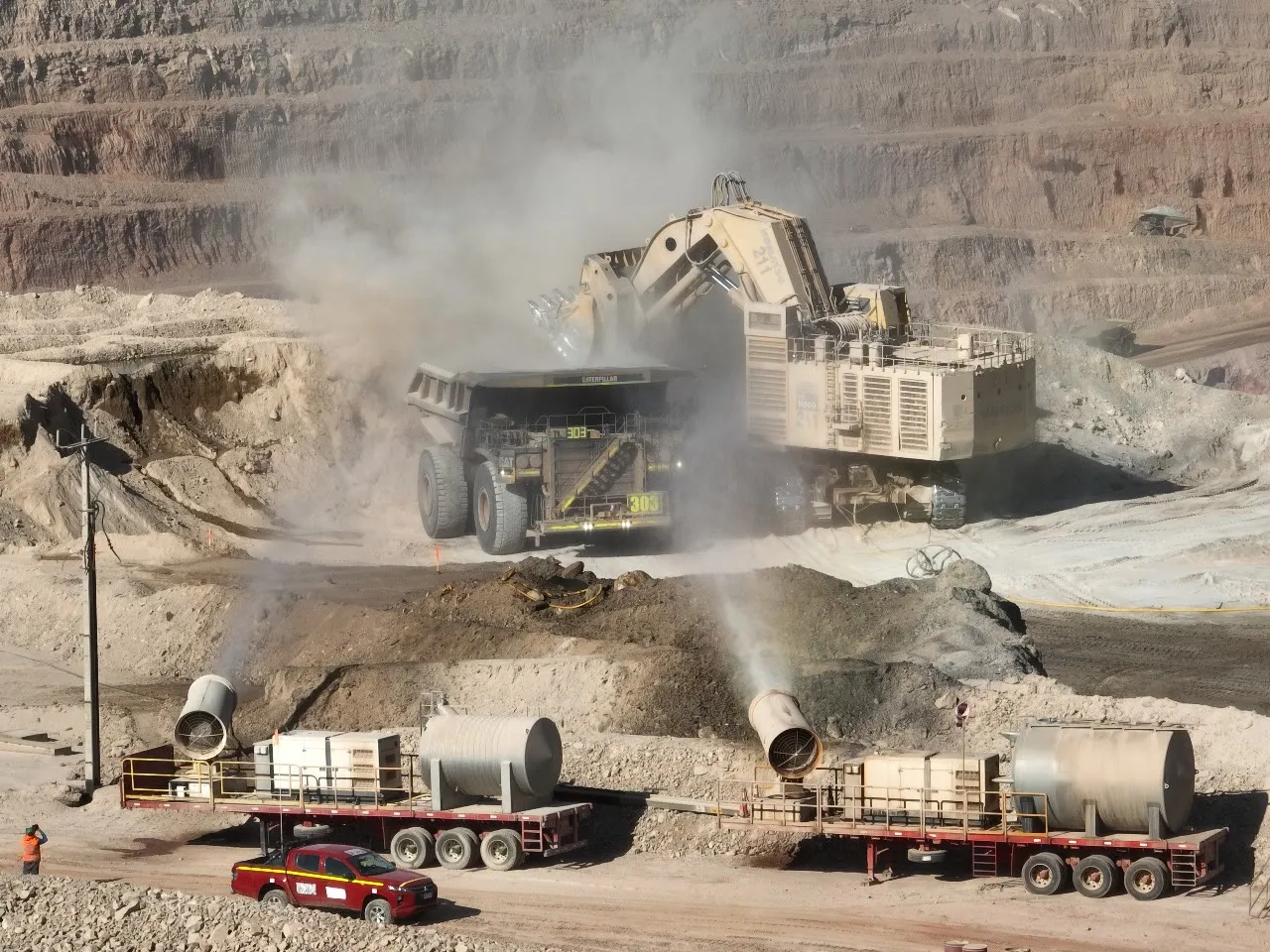
At the loading front, long-range fog cannons project mist with additive over the point where the shovel fills the truck. Efficiency is computed against a baseline measured at the same front.
At a glance
- At loading fronts
- DMS-Cannons® with additive in the mixer tank
- Cannon reach in still air
- 50 to 120 m, depending on the model
- Droplet size
- 20–200 µm
- With cannon and additive
- 80–90% less respirable dust
- Water tank
- 20 m³, 304 stainless steel
- Platform generator
- 150 kW
- Rotation and tilt
- ±90° · −10° to 45°
- Management platform
- DMS-ONE®
Source: DMS-Cannons® technical data sheet.
- less respirable dust with cannon and additive
- 80–90%
- reach in still air, depending on the model
- 50 to 120 m
- water tank, 304 stainless steel
- 20 m³
- platform generator
- 150 kW
Loading fronts: long-range fog cannons with additive
Emissions concentrate at the loading point, where visibility governs safety. The dust is captured in the air, with a curtain of mist where the shovel fills the truck.
- What the cannon does
- A fan-driven atomizer projects a fine water mist, with droplets of 20–200 µm, over long distances. The mist captures airborne dust particles and forms a curtain over the loading point.
- What the additive adds
- The platform's mixer tank doses suppressant into the mist. The solution lasts longer and water consumption is lower.
What is supplied for the front
A complete misting system on a flatbed, on a mobile trailer with brakes: it reaches loading fronts, blast patterns and haul truck dumping areas.
Equipment
Mobile platform with mixer tank
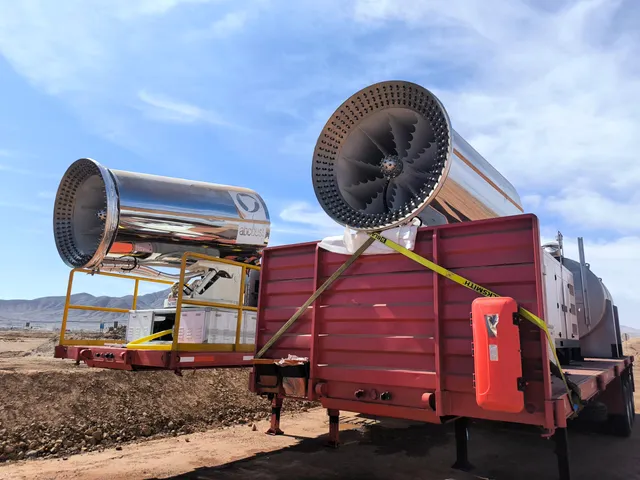
Cannon, water, power and additive dosing travel on a single trailer.
- Long-range fog cannon on its platform
- Mixer tank with doser for adding additive
- 304 stainless steel water tank
- Diesel generator
- Flatbed: mobile trailer with brakes
- Remote and semi-automatic control
- Video camera and anemometer, optional
- water tank, 304 stainless steel
- 20 m³
- platform generator
- 150 kW
- cannon rotation
- ±90°
- hydraulic tilt
- −10° to 45°
Four cannon sizes, by reach in still air
| Specification | DMS-FOG 50 | DMS-FOG 60 | DMS-FOG 80 | DMS-FOG 120 |
|---|---|---|---|---|
| Reach in still air | 50 m | 60 m | 80 m | 120 m |
| Total power | 50 kW | ≈ 50 kW | 50 kW | 56 kW |
| Water consumption | 1,000–2,000 L/h | ≈ 1,300–2,100 L/h | 1,800–2,400 L/h | 12,000 L/h |
| Nozzles | 80 | ≈ 90 | 100 | 100 |
| Weight | 950 kg | ≈ 1,250 kg | 1,900 kg | 2,700 kg |
| Dimensions | 2.0 × 1.7 × 1.5 m | 2.0 × 1.7 × 1.5 m | 3.1 × 1.7 × 2.5 m | 3.1 × 1.7 × 2.5 m |
Our approach
Monitor → Treat → Optimize
A measured baseline, treatment at the source, and verification against that same baseline.
- 01
Monitor
Fixed and GPS-equipped mobile sensors, cameras with computer vision, weather stations and reference gravimetric sampling. The baseline for each section and each front is established first.
- 02
Treat
An hour-by-hour dust risk index built on the forecast, watering scheduled by road segment, an optimal route, execution through the operator app, and remote control of the equipment in the field.
- 03
Optimize
Suppression efficiency computed against the baseline, adherence to schedule, actual water and additive against plan, and road regularity. Exportable report.
What we are asked most
What is the cannon's reach, and what does it need to operate?
Between 50 and 120 m in still air, depending on the model. The cannons run on 400 V three-phase at 50 Hz; the mobile platform carries its own 150 kW generator and a 20 m³ water tank.
Tell us the front, the material and the reach you need
With that we propose the cannon for your loading front and the method by which the result will be measured against your baseline.
Request a loading front assessment