Crushers and conveyors
Crushing, conveyors and transfer points: a control for each fixed emission point
Book a meeting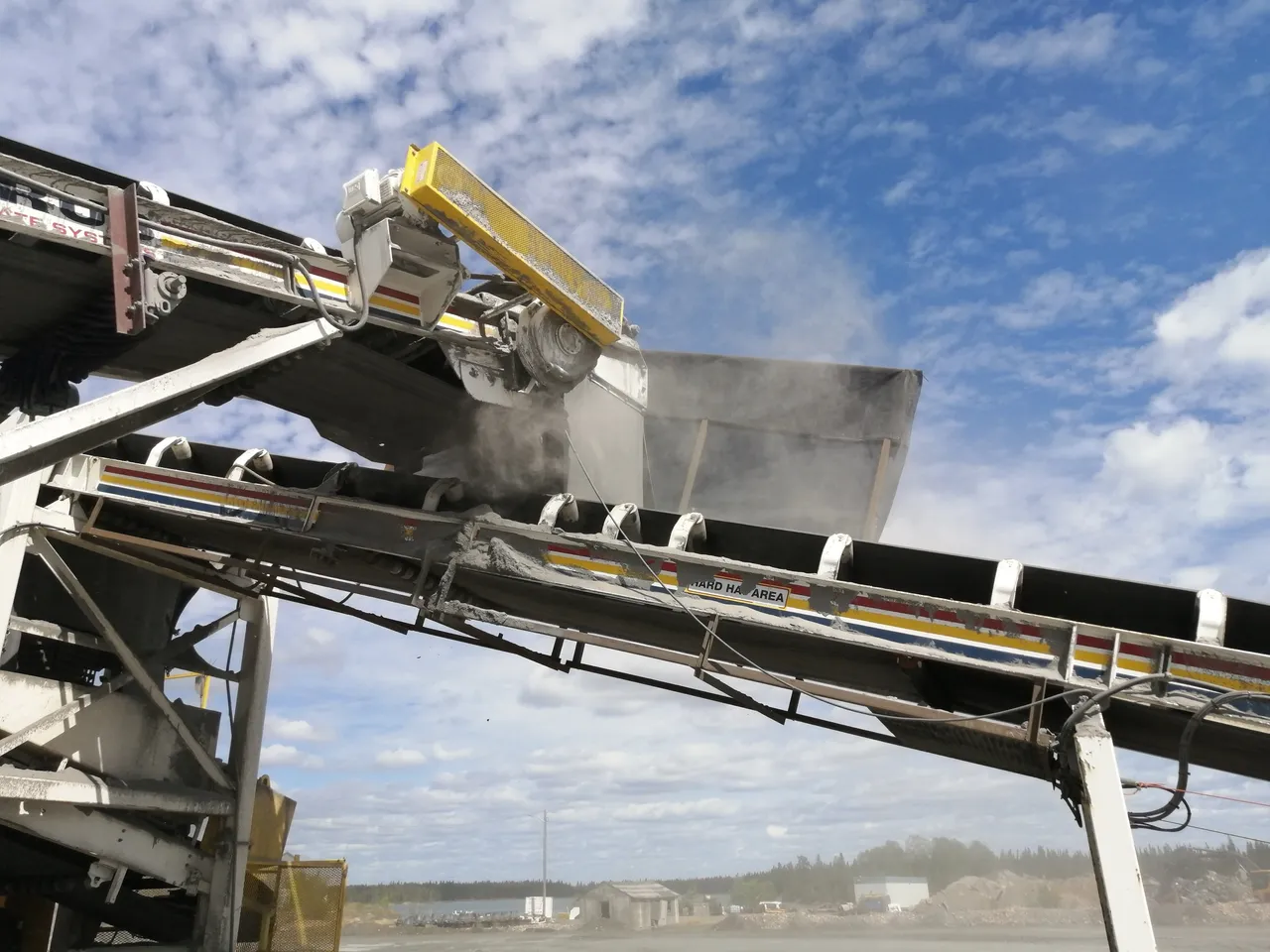
A crushing line emits dust at a few fixed points: the dump hopper, the crushers, the chutes and conveyor transfer points, and the stacker over the stockpile. Each point is controlled at the source with DMS-Fog® dry fog, DMS-TDS® surfactant, a collector, a fog cannon or a wind fence, and the result is verified against a measured baseline.
At a glance
- Emission points
- dump hopper, crushers, chutes, conveyor transfer points, stacker and stockpile
- Indicative share of crushing
- ±35% of a mine site's fugitive dust
- Dry fog
- 4–12 µm droplets, equivalent to the size of the dust
- PM2.5 removal with dry fog
- 75–95% at the emission point
- Dry fog water consumption
- 95–99% lower than conventional wetting
- Moisture added to the material
- 0.1–0.2%, no mud
- Capacity per fog skid
- 6,000 tph: crusher, conveyors and chute
- DMS-TDS® additive
- non-ionic surfactant; over 85% suppression
- DMS-COL® collector
- PM10, PM2.5 and particles < 1 µm
- DMS-Cannons® cannons
- 50 to 120 m reach in still air
- DMS-WF 36® fence at the stockpile
- 60–70% less wind speed
- Committed effectiveness of the fog
- ≥ 75%, verified against the baseline
Source: technical data sheets for DMS-Fog®, DMS-TDS®, DMS-COL®, DMS-Cannons® and DMS-WF 36®, and ABCDust “Crushers and stockpiles” catalog (2024).
- of a mine site's fugitive dust comes from crushing, as an indicative value
- ±35%
- PM2.5 removal with dry fog at the emission point
- 75–95%
- less water than conventional wetting
- 95–99%
- moisture added to the material, no mud
- 0.1–0.2%
The challenge
Emissions concentrate at a few fixed points
The emissions of a crushing line concentrate at a few fixed transfer points. As an indicative value, crushing contributes around 35% of a mine site's fugitive dust.
- Fixed transfer points, always in the same place.
- Dry, fine material.
- Respirable crystalline silica.
- Personnel working close to the source.
Point by point
Which control goes at each point of the line
No single piece of equipment covers the whole plant. Dry fog captures fine dust where the material falls, the DMS-TDS® surfactant is added on continuous belt lines, the collector captures and filters particulate matter, the cannon covers open points and the wind fence protects the stockpile.
- Dump hopper and primary crushertruck dumping
- Dry fog bars over the truck dump into the primary crusher. Where the point is open, a DMS-Cannons® cannon covers the feed and the discharge of the primary crusher. The DMS-COL® collector is compatible with hoppers and discharge points.
- Screensclassification
- DMS-Fog® dry fog over the screen, capturing the fine dust raised as the material is classified.
- Secondary and tertiary crushingfeed and discharge
- Dry fog at the feed to the secondary crusher and at the transfers.
- Chutes and conveyor transfer pointswhere the material drops onto the next belt
- Two DMS-FOG manifolds under the discharge pulley capture the dust right where the material falls, with protected nozzles and shut-off valves accessible for maintenance. On continuous belt lines DMS-TDS® is added, and the DMS-COL® collector adapts to conveyors and discharge points.
- Conveyor beltsrun between transfer points
- Fog while the belt carries material, with manifolds in the conveyor version and belt enclosure with side fog bars.
- Stacker and stockpileend of the line
- Fog at the stacker's discharge onto the pile. The DMS-WF 36® fence protects the material as it falls and spreads over the stockpile, and the DCT-M6 tower raises a cannon above stockpiles and process areas. The stockpile surface is sealed with the crust-forming DMS-TSF®, explained in Tailings.
How it works
Dry fog: droplets the size of the dust
The DMS-FOG nozzle mixes compressed air and water to form microdroplets the size of respirable dust. That is why it captures the fine fraction that conventional spraying lets through.
- Large droplet
- The dust flows around it with the air and stays airborne.
- Fog droplet
- It strikes the particle, encapsulates it and settles.
4–12 µm
Dry fog
Captures PM10 and PM2.5 at hoppers, crushers, chutes and conveyor transfer points. It adds only 0.1–0.2% moisture to the material, without creating mud.
30–80 µm
Fine mist
Complements dry fog on coarser particles and in more open discharge areas.
30–40 °C
Tempered water
The skid filters and heats the water. With lower surface tension, the fog is finer and travels farther, does not freeze in winter and performs the same around the clock, with less compressed air.
−40 °C
Functional options for extreme climates
Skid and manifold configurations that operate down to −40 °C, for high-altitude sites and continuous cold-season operation.
Comparison
Four forms of control, side by side
Each control solves a different part of the problem. The table compares dry fog, conventional wet spraying, the cannon and the wind fence.
| Criterion | DMS-Fog® dry fog | Wet spraying | DMS-Cannons® cannon | DMS-WF 36® fence |
|---|---|---|---|---|
| Principle | 4–12 µm microdroplets that strike and agglomerate fine dust | Large droplet, which deflects the fine particle | Fan-driven atomizer; 20–200 µm droplets | HDPE fabric with 10–25% porosity that slows the wind |
| Performance | 75–95% of PM2.5 at the emission point | Low capture of fine dust | 80–90% less respirable dust, with additive | 60–70% less wind speed |
| Water consumption | 95–99% lower than conventional wetting | High | 1,000–2,000 L/h (50 m model) | 0 L: no water or chemicals |
| Moisture in the material | 0.1–0.2%, no mud | Higher; mud and build-up on equipment | — | Adds no water |
| Reach or capacity | ≈ 5 m per nozzle; 70 m² per bar; 6,000 tph per skid | — | 50 to 120 m in still air, depending on the model | Up to 30 m high |
| Cold-weather operation | Tempered water at 30–40 °C; options down to −40 °C | Risk of freezing | 0–50 °C | −35 °C to +40 °C |
| Operating regime | Activated only at each dump | Usually runs continuously | Programmable and remotely operable, according to wind and activity | Passive, around the clock, with no energy consumption |
| Additive | Optional dosing on the skid | DMS-TDS® dissolved in water, through sprayers | Mixer tank that doses additive into the mist | None |
| Where it goes on the line | Hoppers, crushers, chutes and conveyor transfer points | — | Crusher feed and discharge, transfer areas, stockpiles | Stockpiles, conveyor transfers and stackers, crushing plants |
Monitor → Treat → Optimize
Effectiveness measured, not assumed
The same method on every site: a measured baseline, treatment at the source, and verification against that same baseline. Every fog installation is calibrated with Trolex AIR XD real-time particulate monitors and EPA reference equipment.
- 01
Monitor: baseline
Measurement of PM1, PM2.5, PM4 and PM10 on the crushing line and at conveyor skirt boxes, logging wind, humidity, temperature and tph. Red-Box® at the emission point, DMS-AQS® on the perimeter and 24/7 visual monitoring with automatic plume detection.
- 02
Treat: calibration at the source
Adjustment of active nozzles, pressures and additive up to 80–85% suppression.
- 03
Optimize: guarantee ≥ 75%
The calibration leaves a margin over the required effectiveness and is verified with the same methodology. DMS-ONE® computes suppression efficiency against the baseline: efficiency = (reference − measured dust) ÷ reference × 100.
Instruments
Continuous monitoring next to the plant
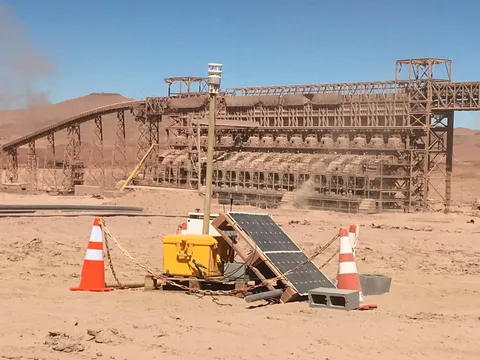
DMS-Extremo® monitors are conditioned for extreme dust levels and protected by Red-Box® and BlueBox® enclosures. The service includes professional weather stations and a methodology that integrates production variables and environmental models.
What we are asked most
Does dry fog wet the ore?
Not to any relevant degree: it adds only 0.1–0.2% moisture, so it creates no mud and does not affect downstream processes.
How much water does it use?
Between 95 and 99% less than conventional wetting. For reference, a 16-nozzle bar uses 654 L/h, and the system is activated only during each dump.
Does it work in winter or at altitude?
Yes. The skid tempers the water to 30–40 °C, which prevents freezing and keeps performance the same day and night, all year round. There are also functional options for operating down to −40 °C.
How is effectiveness demonstrated?
We measure a PM10 and PM2.5 baseline with EPA reference monitors, calibrate the system up to 80–85% suppression and verify, with the same methodology, the committed effectiveness of at least 75%.
What does the site need to install dry fog?
Industrial water (1″ NPT, 1–1.5 bar), compressed air (1½″ NPT, 6–7 bar), 380 V three-phase power and room for a 2.4 × 1.5 × 1.5 m skid. We visit the installation points before fabrication.
Tell us the emission points, the tonnage and the climate of your crushing line
With that we define which control goes at each point and size the skid, the manifolds and the nozzles for your crusher, your conveyors and your stockpile.
Request the sizing for your crushing line